CHEMAZON vs IndiaMART for Chemical Buyers: Direct-Buy vs RFQ
These two platforms are usually described as competitors, which slightly misses the point — they are built to do different jobs, and the comparison is only useful once that is clear. IndiaMART is a horizontal lead-generation portal spanning every B2B category in India, and it is the best supplier-discovery tool in the country. CHEMAZON is a transactional marketplace for chemicals: it carries the order, so verification and documentation sit on the platform rather than on you. If you are choosing between them, you are really choosing between reach and structure.
Disclosure: CHEMAZON is our platform and publishes this comparison — read it with that in mind. Method: all statements about IndiaMART were checked against IndiaMART’s own public pages on 23 July 2026 and are cited under Sources. We make no claim about IndiaMART’s pricing, subscription costs or review scores, and we have tried to state its strengths as plainly as our own.
The short version
If you do not know who supplies a material, start on IndiaMART — its supplier base is deeper than anything else available in India, and no amount of structure compensates for a catalogue that does not contain what you need. If you know what you need and the problem is comparing offers, verifying the seller and getting documentation that survives an audit, CHEMAZON is built for that and IndiaMART is not trying to be.
Many buyers use both: IndiaMART to discover the market, a transactional platform to buy the grades they repeat.
The structural difference: who gets paid when
IndiaMART earns from sellers who pay for listings and access to buyer requirements. Revenue arrives when a lead is delivered, regardless of whether your order ever completes. That is what makes discovery so good — the incentive is to have every supplier and every requirement on the platform — and it is also why your phone rings after you post a requirement, why a listed rate still routes you to “Get Best Price” rather than a checkout, and why the platform steps back once the introduction is made.
CHEMAZON earns commission on completed transactions. Revenue arrives only if the trade actually works, which makes verification, batch documentation and returns handling the platform’s own interest rather than a cost centre. The same incentive explains the limitation: every seller is KYC-verified before listing, so the catalogue grows slowly compared with a portal that accepts anyone who subscribes.
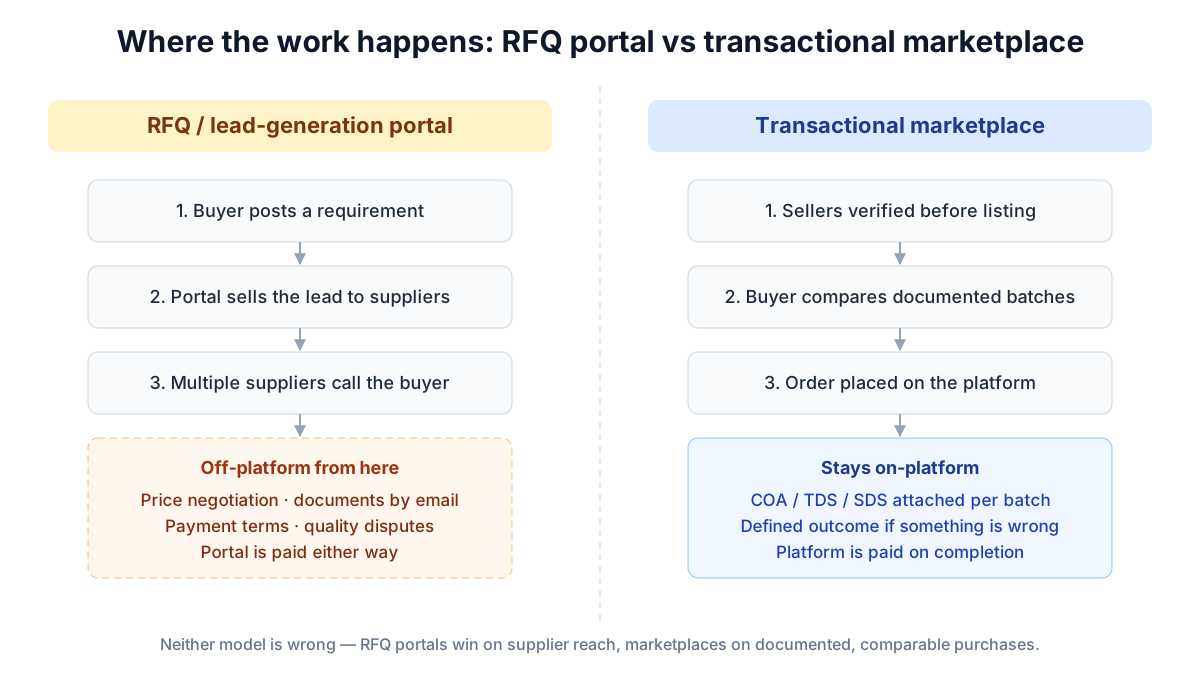
Head to head
How the two platforms differ at each stage of a purchase. IndiaMART column verified against its public pages on 23 July 2026.
| At this stage… | IndiaMART | CHEMAZON |
|---|---|---|
| Platform model | RFQ / lead generation, all B2B categories | Transactional marketplace, chemicals only |
| Catalogue breadth | Very large — the deepest supplier base in India | Small and growing; chemicals in India only |
| Seeing a price | Often a rate on the listing, confirmed by a quote | The order price, visible after sign-in |
| Seller verification | Badge system — “TrustSEAL”, “Verified Exporter”, response rate | KYC (GST/IEC/PAN) and seller contract before listing |
| Batch documentation | Not part of the listing — request from the supplier | COA, TDS and SDS attached per batch |
| Placing the order | Off-platform, direct with the supplier | On-platform; payment within 4 hours of confirmation |
| If the batch is off-spec | Resolved privately with the supplier | Return raised on-platform; approved returns refunded by the seller per contract |
| How the platform earns | Seller listings and lead access | Commission on completed transactions |
Where IndiaMART wins
Reach, and it is not close. For an uncommon intermediate, a specific packing size, or a supplier in a particular city, IndiaMART is likely to surface options that a curated marketplace simply does not carry yet. It costs a buyer nothing to post a requirement, responses arrive quickly, and the breadth extends far beyond chemicals — if you also buy packaging, equipment or industrial consumables, one platform covers all of it.
It is also the better tool for price discovery in a thin market. When only a handful of suppliers make a material, collecting quotes from all of them is exactly the right move, and an RFQ portal is purpose-built for that.
Where CHEMAZON wins
Everything downstream of finding the supplier. The price shown after sign-in is the price the order is placed at rather than a rate a quote will replace, so three grades can be compared without three phone calls. Sellers complete KYC verification and sign a contract including refund obligations before they list, so the counterparty check is done before you arrive rather than by you afterwards. Batch-level COA, TDS and SDS sit on the listing, which means a specification mismatch is caught before the order instead of after delivery — the single most expensive category of chemical procurement error.
And there is a defined path when something goes wrong. Returns are raised on-platform for reasons such as wrong material, quality issues, leakage or wrong batch, and approved returns are refunded by the seller under the seller contract. On an RFQ portal, that recourse depends entirely on what you agreed privately with the supplier.
Being straight about CHEMAZON’s limitations
A comparison written by one of the parties is worth little unless it states where that party is weaker, so: the catalogue is a fraction of IndiaMART’s and will be for a long time, because pre-listing verification is slow by design. Coverage is chemicals in India only — no packaging, no equipment, no export directory. The brand is new, without twenty years of supplier relationships behind it. And payment is currently completed manually rather than through an online gateway, so the order flow is structured but not one-click.
If the material you need is not listed, none of the structural advantages matter. Use IndiaMART, buy it there, and check back later.
The costs neither platform puts on the page
Comparing platforms on features misses where the money actually goes. Three costs dominate chemical procurement and neither platform shows them to you, so it is worth being explicit about which model absorbs which.
The first is quote-collection time. Getting three comparable offers from an RFQ portal is rarely three phone calls — it is three calls, three follow-ups, and then the work of normalising quotes that assume different packing sizes, freight terms and payment windows before they can be compared at all. Half a day is normal for a routine reorder. On a platform where the price sits on the listing, that half-day disappears, but only for materials that are actually listed.
The second is the cost of an off-spec batch, and it is the one that dwarfs everything else. A drum that fails your incoming check is not just a refund problem: it is a stopped line, a reprocessing decision, sometimes a failed shipment to your own customer. Batch documentation available before you order is a control against that specific failure. Documentation requested after a negotiation has begun is not — by the time the COA arrives, you are usually committed.
The third is supplier onboarding. Every new counterparty means verifying registration, confirming licences for the specific chemical, agreeing terms and absorbing the risk of a first order. On an RFQ portal you carry that in full, each time. On a marketplace that verifies before listing and holds a seller contract, most of it is done before you arrive. Neither model removes the check entirely — you should still match the COA batch number to your invoice on delivery, whatever the platform promised.
Using both, deliberately
The framing of "which one should I use" is usually wrong for a procurement team with more than a handful of inputs. Discovery and execution are different problems with different best tools, and the sensible pattern splits them.
Use the horizontal portal when the question is who exists — a new material, an unusual grade, a packing size nobody stocks, a supplier who can deliver to an awkward location. Post the requirement, take the calls, find out what the market looks like. Then use a transactional platform for the materials that have settled into a routine: standard grades, predictable volumes, orders where the value is in speed and documentation rather than in discovering a new supplier. Most of a chemical spend is the second kind, which is why the two-platform pattern works.
Which to use, by buyer type
| You are… | Better fit | Why |
|---|---|---|
| Sourcing a material for the first time | IndiaMART | You need breadth before you need structure |
| Reordering a standard grade monthly | CHEMAZON | Visible pricing and batch documents remove the repeat work |
| In a regulated or audited process | CHEMAZON | Batch COA/TDS/SDS gives you an auditable trail |
| Buying non-chemical inputs too | IndiaMART | One platform across every B2B category |
| Burned by an off-spec delivery before | CHEMAZON | Pre-listing verification and a defined return path |
Frequently asked
Is CHEMAZON a competitor to IndiaMART?
Only partially. IndiaMART is a horizontal lead-generation portal across all B2B categories; CHEMAZON is a transactional marketplace for chemicals in India. They overlap on chemical sourcing, but IndiaMART is built to generate supplier conversations and CHEMAZON is built to complete documented orders. Many buyers use both at different stages.
Can I see chemical prices on CHEMAZON without an inquiry?
Yes, and the distinction matters. IndiaMART chemical listings often display a rate too, but it sits next to “Get Best Price” and is confirmed by the quote that follows. On CHEMAZON the price shown after sign-in is the price the order is placed at, so grades and sellers can be compared without an inquiry or a callback.
What happens on each platform if a chemical batch arrives off-spec?
On an RFQ portal, the order was placed off-platform, so resolution depends on whatever you agreed privately with the supplier. On CHEMAZON, returns are raised on-platform for reasons including wrong material, quality issues, leakage and wrong batch, and approved returns are refunded by the seller under the seller contract they signed before listing.
Does CHEMAZON have as many chemical suppliers as IndiaMART?
No, and it will not for a long time. Every seller completes KYC verification (GST/IEC/PAN) and signs a seller contract before listing, which grows the catalogue far more slowly than a model that accepts any seller who subscribes. If a material is not listed, a horizontal portal is the better place to find it.
Which is better for buying industrial chemicals online in India?
For actually completing a purchase with visible pricing, pre-verified sellers and batch-level COA/TDS/SDS, a transactional marketplace such as CHEMAZON. For discovering who supplies an unusual material anywhere in India, IndiaMART. The choice depends on whether your bottleneck is discovery or execution.
Sources
- IndiaMART homepage — RFQ/lead-generation model and verified-seller connection messaging — checked 23 July 2026
- IndiaMART — industrial chemicals category — Listing-level evidence: rates such as “₹ 205 / Kilogram” shown next to “Contact Supplier” / “Call Now” / “Get Best Price”, “TrustSEAL” and “Verified Exporter” badges, response rate, no COA/TDS/SDS — checked 23 July 2026
Ready to source from verified suppliers?
Browse lab-tested industrial chemicals, compare verified manufacturers, and sign in for member pricing.