COA vs TDS vs SDS: What Each Chemical Document Means
When you buy industrial chemicals, three documents do most of the trust-building: the COA, the TDS and the SDS. They sound similar but answer very different questions — one proves what a specific batch actually contains, one describes the product in general, and one tells you how to handle it safely. Confusing them is one of the most common mistakes new B2B buyers make.
What is the difference between a COA, a TDS and an SDS?
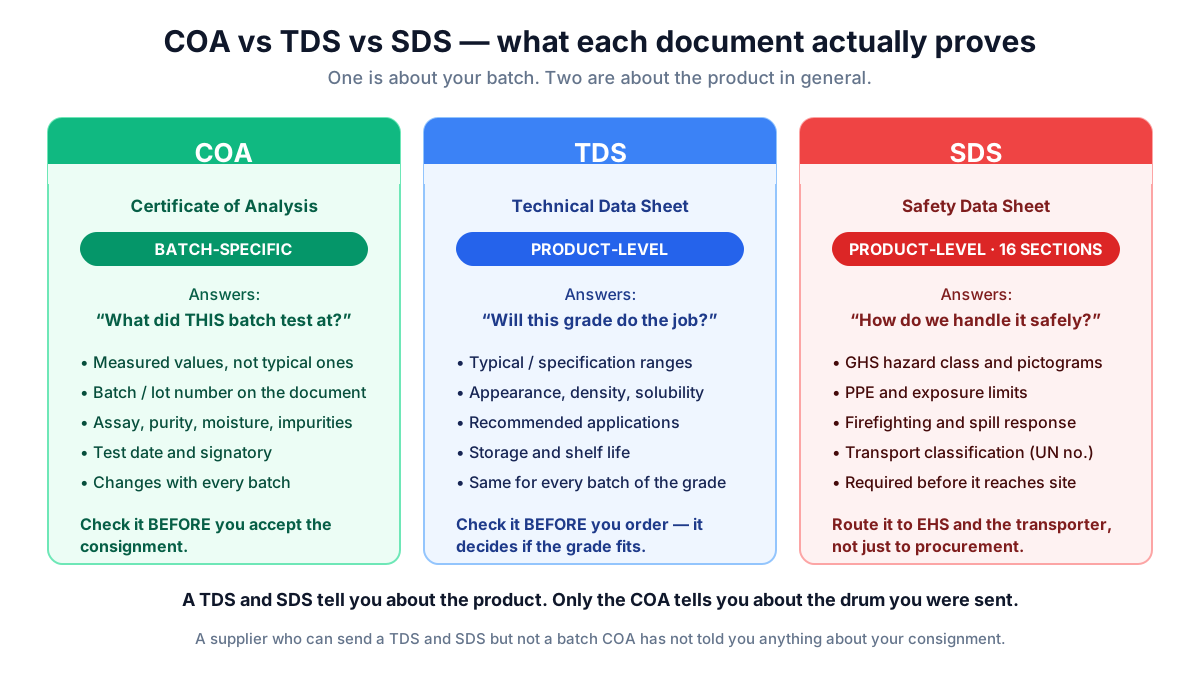
A COA (Certificate of Analysis) is batch-specific: it reports the measured test results for the one production batch you are being sent. A TDS (Technical Data Sheet) is product-level: it states the typical properties, grade and intended applications of the material in general. An SDS (Safety Data Sheet) is also product-level and follows a standard 16-section format covering hazards, handling, storage, transport classification and emergency response.
The distinction that matters commercially is batch versus product. The TDS and SDS describe a grade and stay the same from one order to the next; the COA changes with every batch and is the only one of the three that tells you anything about the material actually arriving on your dock. A supplier who can produce a TDS and an SDS but not a batch COA has told you what the product is supposed to be, not what you are buying.
What does a Certificate of Analysis (COA) prove?
A Certificate of Analysis reports the actual measured results for one production batch — assay or purity, moisture, pH, specific gravity, heavy metals and any other tested parameter — set against the product specification so you can see pass or fail per line. It is issued after that batch is made and tested, which is why two batches of the same grade from the same supplier can carry visibly different numbers.
Because it is batch-specific, a COA is only evidence if its batch number matches the batch on your invoice and on the drum. Checking the document but not the batch number is the most common way buyers accept an undocumented consignment while believing they have verified it.
- Proves: what this exact batch contains, by test.
- Look for: batch or lot number, manufacturing and test date, each tested parameter against its spec limit, and the name of the testing party.
- Red flag: a COA with no batch number, or one whose batch number does not match the invoice and the physical packing.
- Red flag: identical values across several batches — real measured results vary within the spec range.
What does a Technical Data Sheet (TDS) prove?
A Technical Data Sheet describes the product as a grade: typical or specification ranges for its properties, appearance, density, solubility, recommended applications, storage conditions and shelf life. It is not tied to a batch and does not change between orders, so it answers a design question rather than an acceptance question — will this grade do the job in my process at all?
The TDS is the document to read before you shortlist, because it is where grade mismatches surface. Two suppliers offering the same chemical name can be offering different grades with materially different purity, particle size or additive packages, and the TDS is where that becomes visible. Once the grade is right, the COA is what confirms a given batch of it meets spec.
- Proves: what the product is and what it is designed for.
- Look for: grade designation, typical specification ranges, recommended applications, storage and handling notes, shelf life.
- Red flag: a "TDS" that lists no numeric ranges at all — that is a sales sheet, not a data sheet.
What does a Safety Data Sheet (SDS) prove?
A Safety Data Sheet — the current name for what used to be called an MSDS — covers safety and regulatory compliance in a standardised 16-section format. It sets out GHS hazard classification, composition, first-aid and firefighting measures, accidental-release procedures, handling and storage requirements, exposure controls and PPE, physical and chemical properties, stability and reactivity, toxicological information, and transport classification including the UN number and dangerous-goods class.
The SDS is the document your EHS team and your transporter need, not just procurement. It determines whether you are legally able to store the quantity you are ordering at the site you intend to store it, and whether the material needs dangerous-goods documentation in transit. Requesting it after delivery is too late to be useful.
- Proves: how to handle, store, transport and respond to incidents safely and lawfully.
- Look for: GHS hazard class and pictograms, PPE requirements, exposure limits, UN number and DG class, spill response.
- Red flag: an SDS that does not follow the 16-section structure, or one dated years before the current revision of the standard.
COA vs TDS vs SDS at a glance
The three documents answer three different questions. Use this table to keep them straight:
| Document | What it proves | Batch-specific? | Check it before |
|---|---|---|---|
| COA (Certificate of Analysis) | Tested results for one exact batch | Yes | Paying for the order |
| TDS (Technical Data Sheet) | The product's typical properties and intended use | No | Shortlisting the product |
| SDS (Safety Data Sheet) | How to handle, store and transport it safely | No | Storage and transport |
How to use all three together
Run them in order, because each one gates the next. Use the TDS first to confirm the grade suits your process — that is a specification decision and it happens before any supplier is chosen. Use the SDS second to confirm you can legally store the quantity at your site and move it under the right transport class; if the answer is no, the commercial terms are irrelevant. Use the COA last, against the specific batch, immediately before you release payment or accept the consignment.
The failure mode this ordering prevents is the common one: agreeing a price and lead time against a TDS, then discovering at delivery that the batch COA reports a purity at the bottom of the range, or that the SDS puts the material in a DG class your transporter is not licensed for. Both are cheap to catch early and expensive to catch on the dock.
On CHEMAZON, batches carry COA/TDS/SDS documentation so you can run this check at the batch level before ordering — which is exactly why batch-level documentation matters for B2B procurement.
- Which B2B portals actually show you these documents →
- Caustic soda flakes — batch COA/TDS/SDS on the listing →
- Soda ash light — batch COA/TDS/SDS on the listing →
- Sodium bicarbonate — batch COA/TDS/SDS on the listing →
- Caustic soda by CAS number (1310-73-2) →
- Chlorinated paraffin wax by CAS number (85535-84-8) →
Frequently asked
Is a COA the same as a TDS?
No. A COA reports the tested results for one specific batch, while a TDS describes the product’s typical properties and intended use in general. You need both: the TDS to choose the product and the COA to verify the batch.
Is MSDS the same as SDS?
Yes — SDS (Safety Data Sheet) is the current name for what used to be called the MSDS. Both cover the same safety and handling information in a standardised format.
Which document should I check before paying?
Check the COA for the exact batch you are buying and confirm its batch number matches the invoice. Use the TDS and SDS to confirm suitability and safe handling before that.
Ready to source from verified suppliers?
Browse lab-tested industrial chemicals, compare verified manufacturers, and sign in for member pricing.