Best B2B Chemical Marketplaces in India (2026), Compared
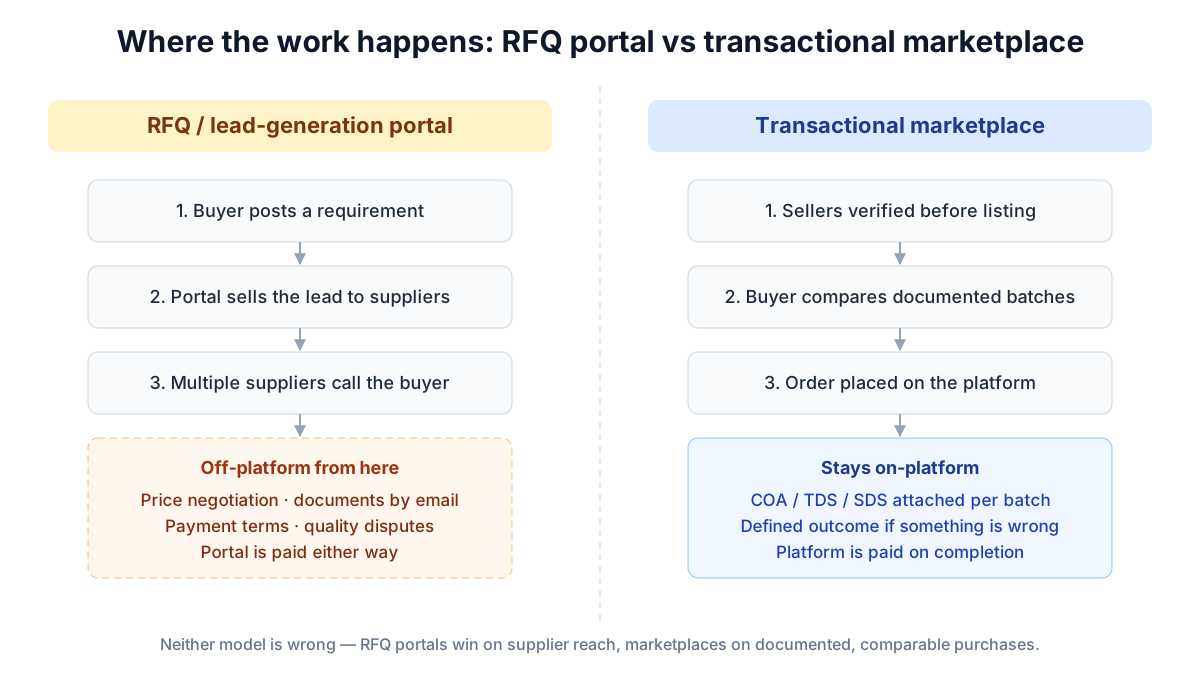
Search for a chemical supplier in India and you land on the same handful of platforms — but they are not interchangeable. Most are lead-generation portals: you describe a requirement, suppliers call you, and everything that matters afterwards happens off-platform. A smaller number carry the order itself. That single structural difference decides whether you spend the next week fielding calls or the next hour comparing documented batches, and it is invisible from the search result. This comparison sets out what each platform actually does, verified against their own public pages.
Disclosure: CHEMAZON publishes this comparison and is one of the platforms listed. Method: every third-party claim below was checked against the platform’s own public pages on 23 July 2026 and is cited under Sources; nothing is taken from marketing material or paid listings. No pricing, subscription cost or review-score claim is made about any competitor — those change without notice, and a stale number is worse than none. Platforms change; if you find something out of date here, tell us and we will correct it.
How these platforms were compared
Five criteria, chosen because they are the ones that change what a chemical purchase actually costs you — not the ones that make for a longer feature list.
- Transaction model: does the platform hand you a contact (RFQ/lead generation) or carry the order, with confirmation, payment terms and a defined outcome if something goes wrong?
- What the price commits to: is the number on the listing one you can place an order at, or an indicative rate that a quote will replace?
- Seller verification: is verification done before a seller can list, or is it a badge you have to interpret yourself?
- Batch documentation: are COA, TDS and SDS attached to the specific batch you are buying, or is documentation something you request afterwards by email?
- Chemical specificity: is the platform built for chemicals — CAS numbers, grades, purity, packing, hazard class — or are chemicals one of a thousand categories?
The real dividing line: RFQ versus direct-buy
India’s large horizontal B2B portals are built around a request for quote. You post what you need, the platform distributes that requirement to suppliers who have paid for lead access, and those suppliers contact you. The portal earns from seller subscriptions and paid listings, which means it is paid whether or not your order ever completes. That is not a criticism of the model — it is extremely effective at discovery, and no marketplace in India matches their supplier reach. It simply means the platform’s job ends where your risk begins.
A transactional marketplace inverts that. The order is placed on the platform, so verification, documentation and dispute handling become the platform’s problem rather than yours. The trade-off is scale: a platform that verifies every seller before listing will always have a smaller catalogue than one that lists anyone who pays. Knowing which trade-off you want is most of the decision.
Comparison at a glance
How the five platforms compare on the criteria above. Verified against each platform’s public pages on 23 July 2026 — see Sources.
| Platform | Model | What the listed price is | Batch COA/TDS/SDS | Scope |
|---|---|---|---|---|
| CHEMAZON | Transactional — order placed on-platform | The price you order at, after sign-in | Yes — attached per batch | Chemicals only, India |
| IndiaMART | RFQ / lead generation | Often shown (₹/kg), but next to “Get Best Price” / “Contact Supplier” | Not part of the listing | All B2B categories, India |
| TradeIndia | RFQ / lead generation | Often shown with MOQ, next to “Ask for a Quote” / “Get Best Quote” | Not part of the listing | All B2B categories, India |
| ExportersIndia | Directory + buy-requirement posting | Not shown | Not part of the listing | All B2B categories, export-focused |
| WorldOfChemicals | Chemical directory, inquiry-based | Not shown | Not part of the listing | Chemicals, global |
What a listed price on a B2B portal actually means
A common assumption — that the horizontal portals hide their prices — is wrong, and worth correcting because it leads buyers to the wrong conclusion. Browse the chemical categories on IndiaMART or TradeIndia and many listings do show a rate: ₹205 per kilogram, ₹240 per kilogram with a minimum order quantity of 100 kg. The number is right there before you contact anybody.
What that number is not is a price you can order at. It sits beside “Get Best Price”, “Contact Supplier”, “Ask for a Quote” or “Get Best Quote”, because the transaction still happens through a conversation. It typically assumes a packing size and a freight basis you cannot see from the listing, reflects whenever the seller last updated it, and is superseded by the quote you eventually receive. It is a useful signal for building a budget and a poor basis for a purchase order.
That distinction is the honest version of the comparison. The gap between a horizontal portal and a transactional marketplace is not price visibility — it is whether the number binds, and whether the documentation you need to check the material arrives before or after you have committed.
1. CHEMAZON — best for documented, repeat industrial purchasing
CHEMAZON is a transactional marketplace for industrial and laboratory chemicals in India. Sellers complete KYC verification (GST, IEC and PAN) and sign a seller contract — including refund obligations to the buyer — before they can list anything. Listings carry batch-level COA, TDS and SDS, so purity, grade and hazard class can be checked against your specification before you commit rather than after delivery. Pricing is visible once you sign in, orders are confirmed on-platform, and payment is completed within four hours of confirmation to hold reserved stock. Returns are raised on the platform for reasons such as wrong material, quality issues, leakage or wrong batch, and approved returns are refunded by the seller under that contract.
Where it is weaker: the catalogue is a fraction of the size of a horizontal portal’s, because verifying every seller before listing is slower than accepting every seller who pays. It covers chemicals only, and it is India-focused — it is not the place to source an export buyer or a non-chemical input. Payment is currently completed manually rather than through an online gateway.
- Best for: buyers who need the paperwork to survive an audit, and who reorder the same grade regularly.
- Weakest for: rare or one-off specialties that no verified seller lists yet, and export sourcing.
2. IndiaMART — best for discovery and reach
IndiaMART is the largest horizontal B2B portal in India and the default result for almost any “{chemical} supplier” search. Its buyer flow is a request for quote: the homepage asks “Tell Us What Are You Looking For?” and listings carry “Contact Supplier”, “Call Now” and “Get Best Price” actions, with sellers responding to your requirement. The chemical category pages are more informative than the model suggests — many listings show a rate per kilogram alongside grade, purity and packaging, the supplier’s city, years in business, a response rate and badges such as “TrustSEAL” and “Verified Exporter”. For finding out who supplies a given material anywhere in India, nothing else comes close.
The cost of that reach is that everything after discovery is yours to manage. The rate on the listing is indicative and confirmed only by the quote that follows, so genuine comparison still means collecting offers. The badges tell you a seller met IndiaMART’s criteria, not that they hold a licence for your specific chemical. Batch documentation is not part of the listing — no COA, TDS or SDS appears on the chemical category pages — so documents are requested by email after the fact. And because suppliers pay for lead access, a single inquiry commonly produces calls from several of them.
- Best for: discovering suppliers outside your existing network, especially for uncommon materials.
- Weakest for: comparing like with like, and for buyers who want a price without a phone call.
3. TradeIndia — best for reading the market before you quote
TradeIndia is the closest structural equivalent to IndiaMART and works the same way: “Send Inquiry” and “Post Buy Requirement” are the primary buyer actions, with WhatsApp contact offered on listings. Where it is marginally more useful for early research is that its chemical listings pair the rate with an explicit minimum order quantity — “240 INR/Kilograms, MOQ 100 Kilograms” — which tells you not just a number but the volume that number assumes. IndiaMART’s listings often show a rate without stating the MOQ, and a price per kilogram means very little until you know whether it applies to a 50 kg drum or a tonne.
The caveats are the same. The rate sits beside “Get Best Quote”, “Ask for a Quote” and “Contact Supplier”, so it is a starting position rather than an offer; some listings also carry a “Buy Now” action, though the transaction is still supplier-fulfilled. Verification exists as a badge system — “Trusted Seller”, “Super Seller”, “Super Premium”, alongside a “Member Since” year — which is a reputation signal, not a chemical licence check. No COA, TDS or SDS appears on the listings.
- Best for: sizing a price against a stated MOQ before you start collecting quotes.
- Weakest for: treating a listed rate — or a badge — as a guarantee of anything.
4. ExportersIndia — best for export-oriented sourcing
ExportersIndia is a supplier directory and buy-requirement board oriented toward export trade, describing itself as a B2B marketplace for manufacturers, exporters and suppliers and connecting Indian suppliers to buyers across markets including the UAE, USA, Canada, Malaysia, Singapore, Saudi Arabia and Australia. The buyer actions are “Post Buy Requirement” and “Browse Suppliers”; prices are not shown.
For a domestic Indian buyer purchasing a drum of a common industrial grade, this is the wrong tool — the export orientation adds nothing and the directory model gives you less structure than the larger horizontals. For a buyer outside India sourcing Indian manufacturing capacity, it is genuinely useful.
- Best for: overseas buyers looking for Indian exporters.
- Weakest for: domestic spot purchasing.
5. WorldOfChemicals — best for chemical-specific browsing
WorldOfChemicals is a chemicals-focused B2B directory with buy and sell listings, positioned around “Connecting World Chemically”. Being vertical helps: the taxonomy is chemical rather than generic, so browsing by material behaves more sensibly than on a portal where chemicals sit beside industrial fasteners. It remains inquiry-based — no prices or checkout are exposed on the listings — and it is global rather than India-specific.
- Best for: chemical-specific supplier browsing across geographies.
- Weakest for: transacting, and for India-specific availability.
Which one for which job
Most procurement teams end up using two: one platform to find out who exists, and one to actually buy from once the requirement is stable.
| If your job is… | Start with | Why |
|---|---|---|
| Find anyone who supplies an unusual material | IndiaMART | Largest supplier base in India by a wide margin |
| Size a budget against a stated volume | TradeIndia | Listings pair the rate with an explicit MOQ |
| Buy a documented batch of a standard grade | CHEMAZON | Batch COA/TDS/SDS and verified sellers before listing |
| Source Indian manufacturing from overseas | ExportersIndia | Built around export trade |
| Browse by chemical rather than by category | WorldOfChemicals | Vertical chemical taxonomy |
What to check whichever platform you use
No platform removes your responsibility as the buyer — it only changes how much of the work is done for you. These checks take minutes and catch nearly every avoidable problem.
- Confirm the business has valid KYC (GST/IEC/PAN) and holds the licences required for the specific chemical, not chemicals in general.
- Read the TDS and confirm the grade and typical properties fit your process before comparing prices.
- Match the COA’s batch number to the batch on your invoice, and check the tested results against your own specification.
- Check the SDS hazard class against what your site is legally permitted to store and receive.
- Get the return and refund path in writing before you pay — not after a drum arrives off-spec.
Frequently asked
Which is the best B2B chemical marketplace in India?
It depends on the job. For discovering who supplies an unusual material, IndiaMART’s supplier base is unmatched. For buying a standard industrial grade with batch-level COA, TDS and SDS from a seller verified before listing, a transactional marketplace such as CHEMAZON is a better fit. Most buyers use a discovery platform and a transactional one for different stages.
What is the difference between an RFQ portal and a transactional chemical marketplace?
An RFQ portal distributes your requirement to suppliers who have paid for lead access; they contact you and the deal, documents and any dispute happen off-platform. A transactional marketplace carries the order itself — sellers are verified before listing, batch documents sit on the listing, orders are confirmed on-platform and there is a defined return and refund path.
Can you see chemical prices without submitting an inquiry?
Usually yes, but the number is indicative. Many IndiaMART and TradeIndia chemical listings show a rate per kilogram before you contact anyone — TradeIndia typically states the minimum order quantity alongside it. Both sit next to quote buttons, so the figure is superseded by the offer you receive. On CHEMAZON the price shown after sign-in is the price you place the order at. Verified 23 July 2026.
Why do I get so many calls after posting a requirement on a B2B portal?
Because that is the product working as designed. Lead-generation portals earn from sellers who pay for access to buyer requirements, so one posted requirement is distributed to multiple sellers who each have a paid incentive to call. Platforms that earn commission on completed orders instead have no reason to distribute your contact details.
Do any Indian chemical platforms provide batch-level COA, TDS and SDS on the listing?
Among the platforms compared here, batch-level documentation attached to the listing is not part of the horizontal portals’ model — documents are requested from the supplier after contact. CHEMAZON attaches COA, TDS and SDS at the batch level so the specification can be checked before ordering.
Sources
- IndiaMART homepage — RFQ model and “Tell Us What Are You Looking For?” buyer flow — checked 23 July 2026
- IndiaMART — industrial chemicals category — Listing-level evidence: rates such as “₹ 205 / Kilogram”, CTAs “Contact Supplier” / “Call Now” / “Get Best Price”, “TrustSEAL” and “Verified Exporter” badges, response rate, years in business, no COA/TDS/SDS — checked 23 July 2026
- TradeIndia homepage — “Send Inquiry” / “Post Buy Requirement” flow, “TradeIndia Trusted” and “Premier Seller” badges — checked 23 July 2026
- TradeIndia — abrasive chemicals category — Listing-level evidence: “240 INR/Kilograms” with “MOQ 100 Kilograms”, CTAs “Get Best Quote” / “Ask for a Quote” / “Contact Supplier” / “Buy Now”, “Trusted Seller” and “Super Seller” badges, “Member Since” years, no COA/TDS/SDS — checked 23 July 2026
- ExportersIndia homepage — “Post Buy Requirement” / “Browse Suppliers” flow, export orientation — checked 23 July 2026
- WorldOfChemicals homepage — Chemical directory with buy/sell inquiry listings — checked 23 July 2026
Ready to source from verified suppliers?
Browse lab-tested industrial chemicals, compare verified manufacturers, and sign in for member pricing.