Soda Ash Light vs Dense: Which Grade Do You Need?
Soda ash is quoted as "light" or "dense", and buyers new to it often assume the difference is purity. It is not. Both are sodium carbonate at essentially the same chemical assay; what differs is bulk density, and therefore how the material flows, dusts, segregates and packs. That single physical property is why a glass plant and a detergent plant will specify opposite grades of the same chemical, and why substituting one for the other quietly changes a process.
What is soda ash?
Soda ash is sodium carbonate, Na2CO3, CAS 497-19-8 — a white, water-soluble alkaline salt. Its hydrated form is familiar domestically as washing soda. It is one of the largest-tonnage inorganic chemicals in the world, and the majority of global production is consumed by glass manufacturing.
It is produced either synthetically by the Solvay process, from salt and limestone, or by refining naturally occurring trona deposits. Both routes yield the same substance; the trace impurity profile can differ, which matters for a small number of high-specification uses and for almost none of the rest.
What is the difference between soda ash light and dense?
The chemistry is the same. The difference is bulk density: dense soda ash has roughly twice the bulk density of light soda ash, achieved by producing a coarser, more granular particle rather than by changing the compound.
Everything that follows from that is a handling consequence. Denser, coarser material flows more freely, dusts far less, and segregates less when mixed with other granular solids. Lighter, finer material has more surface area for its mass, which helps where it must dissolve quickly or blend intimately into a powder formulation.
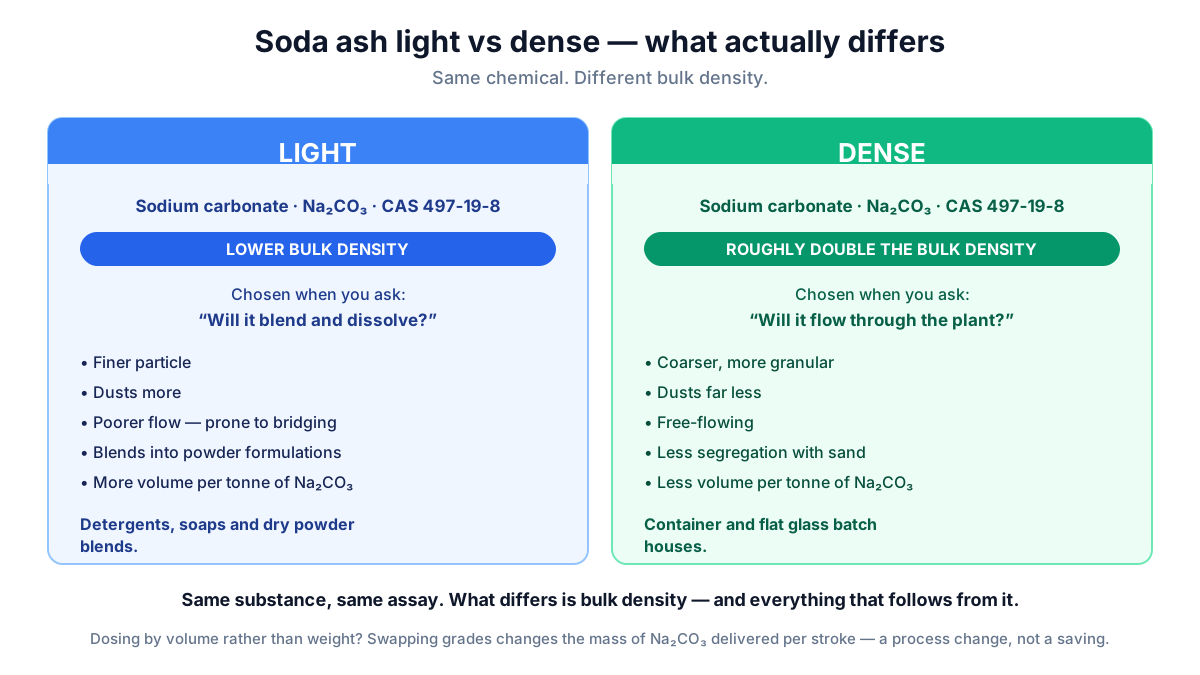
| Property | Light | Dense |
|---|---|---|
| Chemical identity | Sodium carbonate, CAS 497-19-8 | Sodium carbonate, CAS 497-19-8 |
| Bulk density | Lower | Roughly double that of light |
| Particle size | Finer | Coarser, more granular |
| Dusting | More | Less |
| Flow | Poorer, more prone to bridging | Free-flowing |
| Segregation in dry blends | More prone | Less prone |
| Freight per tonne of Na2CO3 | More volume for the same mass | Less volume for the same mass |
Which industries use which grade?
The split follows the handling logic above rather than any convention.
| Application | Usual grade | Why |
|---|---|---|
| Container and flat glass | Dense | Free flow through batch houses; less dust loss; less segregation with sand |
| Detergents and soaps | Light | Blends and dissolves readily into powder formulations |
| Water treatment / pH correction | Either | Dissolution rate usually decides it |
| Chemical manufacturing | Either | Depends on whether it is charged dry or in solution |
| Silicates | Either | Process-specific |
How to choose between them
If your process is established, the honest answer is to buy the grade it was designed around and not to change it on price. Substituting light for dense in a system with volumetric dosing changes the mass delivered per stroke, because you are metering volume and paying for mass. That is a silent process change, not a saving.
- Dosing volumetrically rather than by weight? Bulk density is a process variable — do not substitute grades without recalibrating.
- Blending into a dry powder formulation? Light generally blends and dissolves better.
- Handling through hoppers, screws or a batch house? Dense flows better and dusts less.
- Comparing delivered cost? Compare per tonne of sodium carbonate, and account for the volume difference in freight and storage.
- Operators charging open vessels by hand? Dusting is an exposure consideration, and dense is the lower-dust option.
What to check on the certificate of analysis
Soda ash is a commodity with a narrow specification, so a COA is read less for headline assay than for the parameters that vary and that your process notices.
- Sodium carbonate assay, and the basis it is quoted on.
- Bulk density, when you are relying on it — this is the parameter that defines light versus dense, so a grade claim without a density figure is a description rather than a specification.
- Moisture content, which affects both flow and effective assay.
- Sodium chloride and insolubles, where your process or finished product is sensitive to them.
- Iron, where colour matters — glass and some detergent applications in particular.
- The batch number, matched against your invoice and the bag in front of you.
Frequently asked
Is soda ash light the same chemical as soda ash dense?
Yes. Both are sodium carbonate (Na2CO3, CAS 497-19-8) at essentially the same chemical assay. The difference is physical: dense soda ash has roughly twice the bulk density of light, from a coarser particle. It is a handling difference, not a purity one.
Which is better, soda ash light or dense?
Neither is better in general — they suit different handling. Dense flows freely, dusts less and segregates less, which is why glass batch houses use it. Light has more surface area per unit mass and blends and dissolves more readily, which is why detergent powder formulations use it. Buy the grade your process was designed around.
Can I substitute soda ash light for dense?
Not without checking how you dose it. If your system meters by volume, halving or doubling the bulk density changes the mass of sodium carbonate delivered per stroke, which alters the process while appearing to be a like-for-like swap. Where dosing is by weight, substitution is more forgiving, but flow and dusting behaviour still change.
What is the CAS number of soda ash?
Soda ash is sodium carbonate, CAS 497-19-8. The same CAS number applies to both light and dense grades, because it identifies the substance and not the bulk density.
Is soda ash the same as washing soda?
Washing soda is the hydrated form of sodium carbonate, most familiar as a domestic cleaning product. It is the same substance as industrial soda ash in hydrated form, so the names are often used interchangeably even though the material sold industrially is normally anhydrous.
Is soda ash the same as caustic soda?
No. Soda ash is sodium carbonate (Na2CO3) and caustic soda is sodium hydroxide (NaOH). Both are alkalis used for pH correction, but caustic soda is a far stronger base and carries a more severe corrosive hazard classification. They are not interchangeable without recalculating dosing and reviewing handling.
What is soda ash used for?
The largest use by volume is glass manufacturing, where it lowers the melting temperature of silica. It is also used in detergents and soaps, water treatment and pH correction, silicate manufacturing, and as a feedstock across chemical manufacturing.
Sources
- PubChem — Sodium carbonate (CID 10340) — Substance identity, CAS 497-19-8, physical properties — checked 29 July 2026
Ready to source from verified suppliers?
Browse lab-tested industrial chemicals, compare verified manufacturers, and sign in for member pricing.